Read Before Your Next Hire

5 Things US Founders Don't Know About Hiring South African Finance Talent

The five most commonly overlooked facts about South African finance talent — and why ignoring them could be costing your startup thousands every month.

Read Time

Approximately 9–11 minutes

Applicable To

US Founders

Spoiler Alert

You're probably wasting $50,000 per year

Introduction

There's a moment most Series A and Series B founders know well. You're staring at a spreadsheet at 11pm, your runway is tighter than you'd like, your board wants consolidated financials by Monday, and your finance function — if you have one — consists of a part-time bookkeeper and a prayer.

5 Things US Founders Don't Know About Hiring South African Finance Talent Hero

You need a controller. Maybe a financial business partner. Someone who can build a model, close the books, and talk to your investors without you holding their hand.

Then you look at the market rates.

A US-based controller with the credentials you need is going to cost you between $8,000 and $12,000 a month. A fractional CFO? Add another zero. For a company burning $150K a month and trying to stretch its runway to Series B, that hire can feel impossible.

Here's what most US founders don't know: there's a country on the other side of the world producing finance professionals with world-class credentials, native English fluency, and a deep cultural familiarity with Western corporate norms — at a fraction of US market rates. And almost nobody is talking about it.

South Africa. Not India. Not Eastern Europe. South Africa. And the reasons it works so well for US companies are more nuanced — and more compelling — than most people realise. Here are five things founders consistently get wrong about hiring South African finance talent.


5 Things US Founders Don't Know About Hiring South African Finance Talent Credentials

1. The Qualifications Are Not "Equivalent" — They're Exceptional

When founders first hear about hiring from South Africa, the instinct is to assume a trade-off on quality. You're paying less, so something must give. That assumption is wrong — and understanding why starts with the credentials.

South Africa produces professionals holding some of the most rigorous finance qualifications in the world. The CA(SA) — Chartered Accountant (South Africa) — is widely regarded as one of the most demanding accounting qualifications globally. To earn it, candidates must complete a specialised undergraduate degree, a postgraduate Certificate in the Theory of Accounting (CTA), three years of supervised articles, and pass two board exams — with pass rates that hover around 40–50%.

Beyond the CA(SA), South African professionals hold CIMA, ACCA, and CFA designations in significant numbers — the same credentials valued on trading floors in London and finance departments in New York. And crucially for US companies: SA professionals are trained to both IFRS and US GAAP standards.

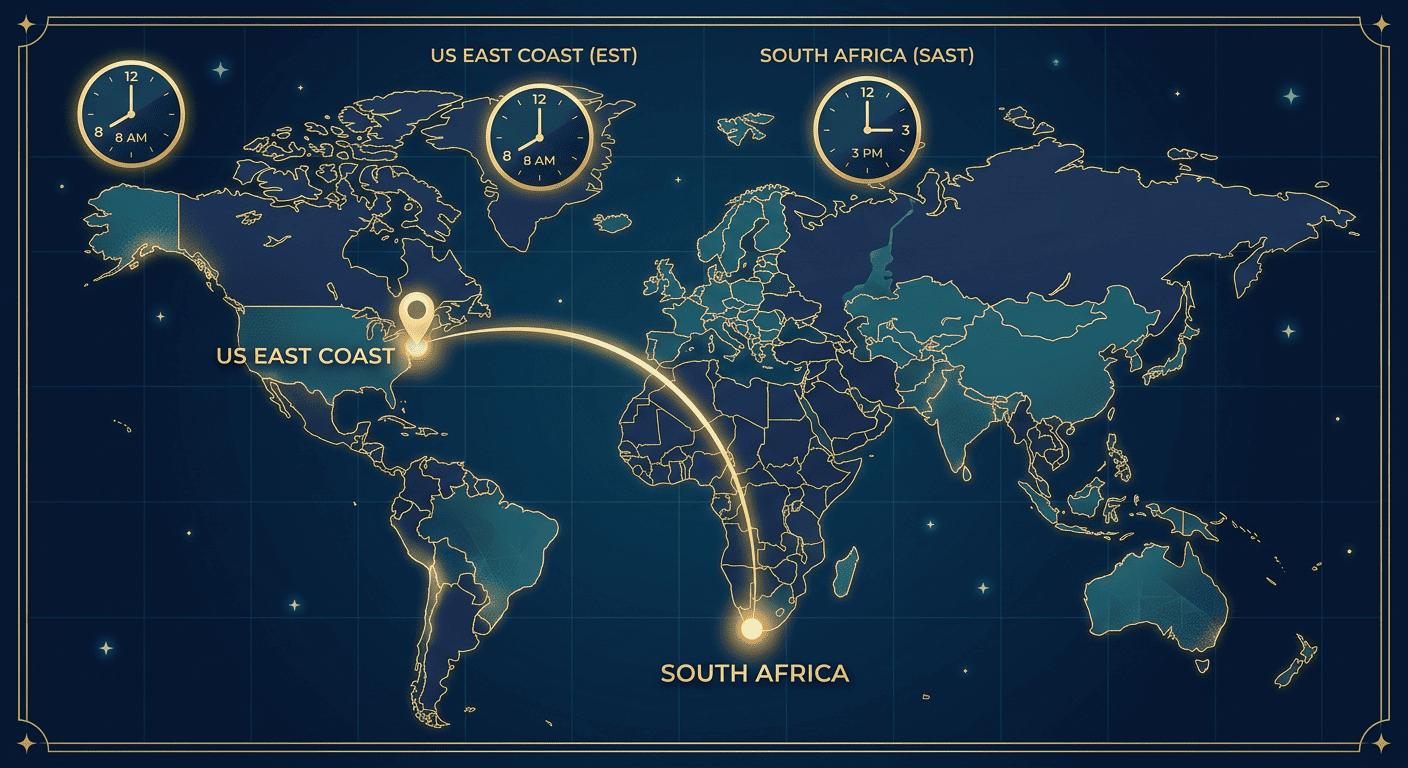
5 Things US Founders Don't Know About Hiring South African Finance Talent Time Zone

2. The Time Zone Overlap Is Real — And It Works

South Africa runs on UTC+2. During US Eastern time, South Africa is 6–7 hours ahead. Here's what that looks like on a Monday morning:

  • 9:00 AM EST — Your SA professional's day is wrapping up (3:00 PM in Johannesburg)
  • 8:00 AM EST — Peak overlap window — they've completed a full morning's work, you're just starting
  • 7:00 AM EST — Real-time collaboration, calls, stand-ups

Your South African finance professional has typically completed 4–5 hours of focused, uninterrupted work before your first coffee of the day. They're available for your morning calls, they're online for Slack messages, and they deliver outputs while you sleep.

We were worried about time zones. In practice, it's become a competitive advantage. Our books are reviewed by 8am every morning. I've never had that with a US-based hire.

CFO, Series B SaaS Company

3. The Cost Differential Is Structural, Not Exploitative

When founders hear that a CA(SA)-qualified controller costs $2,400–$3,500 a month versus $8,000–$12,000 for a US equivalent, the first instinct is to wonder what's wrong. The second is to wonder whether it's ethical. Both questions deserve honest answers.

The differential is structural, not a signal of lower quality. South Africa's cost of living is significantly lower than the United States. A professional earning $2,800 a month in Cape Town is earning a salary that affords a comfortable, middle-class lifestyle — in many cases better than what a US salary equivalent would provide relative to local costs.

For a 10-person startup, replacing a $9,800/month US controller with a $2,800/month SA equivalent frees up $84,000 per year. That's nearly a full additional engineer, or 6 months of extended runway.

4. Cultural Fit Is Closer Than You Think

South Africa's professional culture is shaped by decades of exposure to British and American business norms. English is one of South Africa's 11 official languages — and the dominant language of business, law, and professional services. SA finance professionals don't just speak English; they think, write, and negotiate in it.

SA professionals are familiar with the pace of startup environments. Many have worked with multinational firms (PwC, Deloitte, KPMG, EY all have major SA operations), have managed cross-border relationships, and understand the urgency and directness of US business culture.

5. The Compliance and Contracting Piece Is Simpler Than You Fear

South African finance professionals working for US companies are typically engaged as independent contractors. This means no US payroll taxes, no benefits obligations, no state-specific employment law complexity. You pay a monthly invoice, typically in USD via international wire or platforms like Wise or Deel.

At Accrual Talent, we handle the matching, contracting template, onboarding documentation, and initial compliance review for every placement. Our clients don't need to figure this out from scratch — they inherit a tested process that has been used across dozens of placements.

5 Things US Founders Don't Know About Hiring South African Finance Talent Closing

What This Means for Your Business

If you are building a finance function for a US startup and you have not considered South African talent, you are probably overspending by $50,000 to $100,000 per year — or under-building because you can't afford what the US market is asking. South Africa is not a shortcut. It's a strategic choice.

Let us find your next Super Star

CA(SA) vs CPA: What's the Difference and Which One Does Your Startup Need? Thumbnail

CA(SA) vs CPA: What's the Difference

and Which One Does Your Startup Need?

Read More