Read Before Your Next Hire
CA(SA) vs CPA: What's the Difference and Which One Does Your Startup Need?
A plain-English breakdown of two of the world's most respected finance qualifications — and a practical guide to which one your business actually needs at each stage.
Read Time
Approximately 8–10 minutes
Applicable To
US Founders
Spoiler Alert
You could be saving 80%
Introduction
Most US startup founders have a vague sense that accounting qualifications exist and that some of them matter more than others.
Beyond that, it gets murky fast. CPA is a term you'll hear constantly in the US. CA(SA) is a term you'll likely encounter for the first time when someone suggests you hire from South Africa.
The instinct is to assume that CPA = recognised and CA(SA) = foreign, lesser-known, probably fine but not quite the real thing. That instinct is wrong. And understanding why — in practical, concrete terms — will change how you think about building your finance function.
What the CPA Actually Is
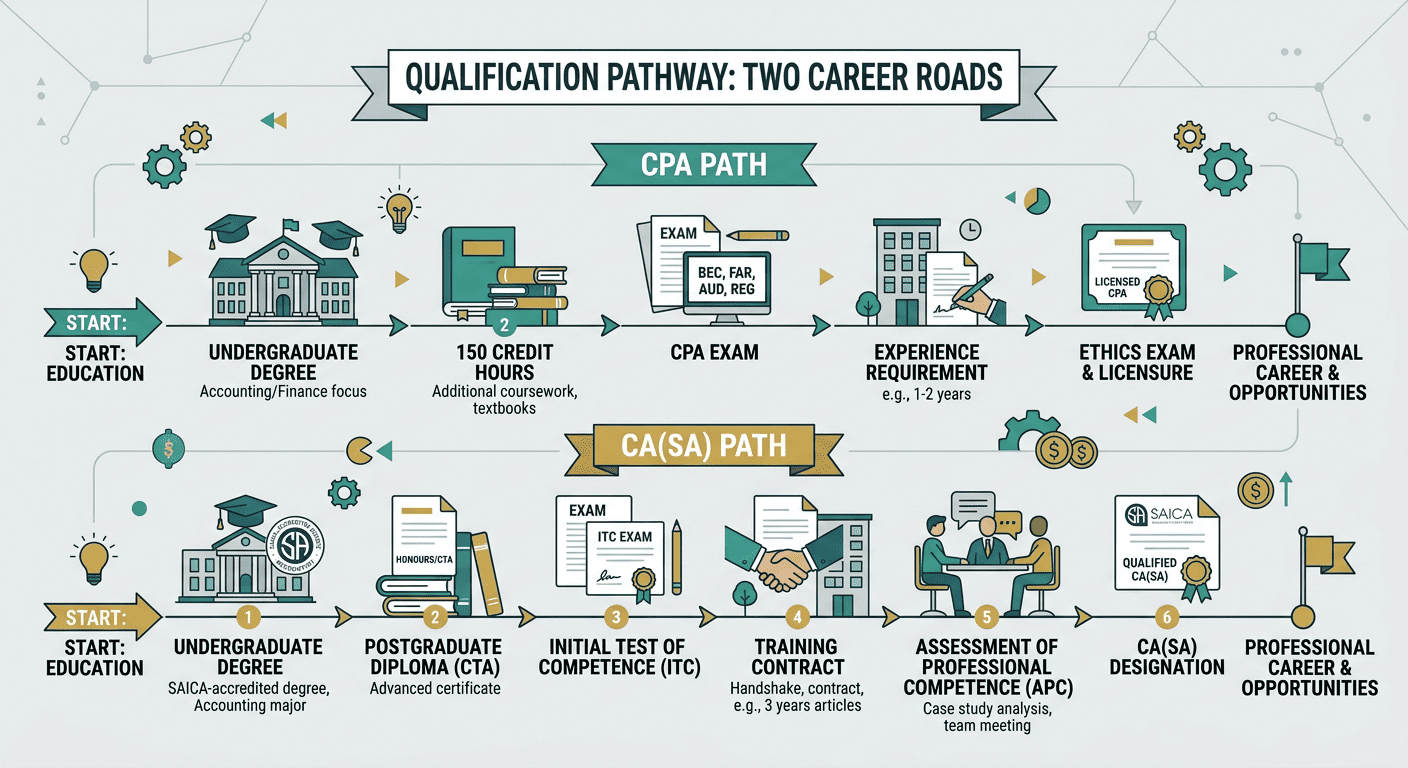
The Certified Public Accountant designation is the primary US accounting credential, administered by the AICPA. To earn it, candidates need 150 semester hours of education, 1–2 years of supervised work experience, and passing scores on four exam sections: FAR, AUD, REG, and BEC. Overall pass rates hover around 45–55%.
CPA holders are trained in US GAAP, US tax law, and US regulatory frameworks. They are exceptionally qualified to work within the US financial system. The limitation is that the CPA is a US-centric qualification — it optimises for US GAAP, US tax, and US compliance.
What the CA(SA) Actually Is
The CA(SA) designation is administered by SAICA and is widely regarded as one of the most demanding professional qualifications in the world. The pathway:
- A specialised undergraduate degree (BComm Accounting or equivalent) — 3 years
- Postgraduate Certificate in the Theory of Accounting (CTA) — 1 year
- Three years of structured articles (supervised training) at an accredited firm
- Two board examinations — the ITC and APC — with combined pass rates of roughly 40–50%
The total pathway from first-year student to qualified CA(SA) is typically 7–8 years. CA(SA) holders are trained to both IFRS and US GAAP standards, with strong financial modelling capabilities and Big Four audit experience.
At Accrual Talent, we place CA(SA)-qualified controllers and FP&A professionals with US startups at every stage.
Head-to-Head: What Each Qualification Optimises For
US GAAP expertise: CPA has the edge — it is US GAAP-native. CA(SA) holders know US GAAP but their primary framework is IFRS.
IFRS expertise: CA(SA) wins comprehensively — trained to the international standard from day one.
Financial modelling and FP&A: Broadly comparable; CA(SA) training emphasises integrated financial thinking earlier.
US tax law: CPA has a clear edge — US tax is a core exam section. CA(SA) holders are not US tax specialists.
Business partnering: CA(SA) qualification is specifically designed to develop commercial thinkers with judgment-based reasoning.
Cost: US-based CPAs command $8,000–$15,000/month for controller-level roles. CA(SA)-qualified controllers typically cost $2,400–$3,500/month.
Which One Does Your Startup Actually Need?
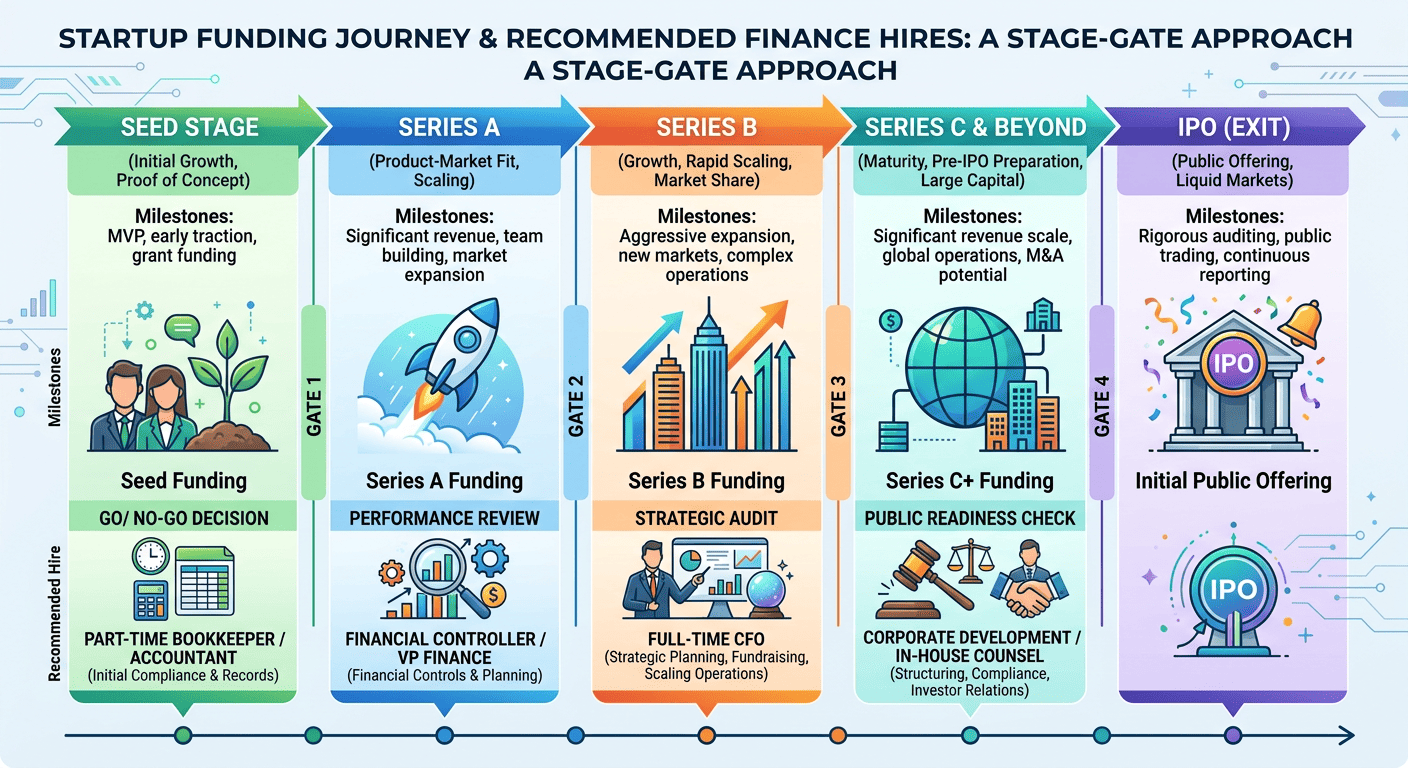
Pre-seed to Seed
You don't need a CPA or a CA(SA) yet. A solid bookkeeper or junior accountant is sufficient.
Series A ($2M–$10M raised)
This is the ideal moment for a CA(SA)-qualified controller. They'll build your reporting infrastructure, manage your close process, prepare board packs, and start building analytical capability. At $2,400–$3,500/month, the cost is a fraction of a US equivalent — and the output is equivalent or better.
Series B ($10M–$50M raised)
A CA(SA)-qualified financial controller or FP&A lead, potentially paired with a fractional CA(SA) CFO. You may also want a US-based CPA for tax strategy specifically.
Series C and beyond
Build a full finance team. The CA(SA) controller often grows into VP Finance. Add US CPA specialists for tax and possibly a US-based CFO as you approach IPO readiness.
The Hybrid Model That Works Best
The smartest early-stage finance function combines: (1) A CA(SA)-qualified controller handling day-to-day management, close, reporting, and FP&A. (2) A US-based CPA firm for annual tax filing and regulatory requirements. (3) A fractional CFO for board relationships and strategic planning.
This model costs roughly $4,000–$6,000 a month all-in. The equivalent US-only model typically runs $15,000–$25,000 a month.