Read Before Your Next Hire
Why UTC+2 Makes SA Professionals Ideal for US Remote Teams
Your SA finance hire works 5 hours before you wake up. Here's what that means for your Monday morning inbox
Read Time
Approximately 7–9 minutes
Applicable To
US Founders
Spoiler Alert
Get 60% more productivity
Introduction
When companies think about hiring internationally, time zone is almost always the first objection.
"We're based in New York. How is this going to work if they're in South Africa?" It's a fair question. And the honest answer — which surprises almost every founder who hears it — is that South Africa's time zone is genuinely one of its strengths for US remote teams, not a liability. Let's go through the data.
The Basic Maths
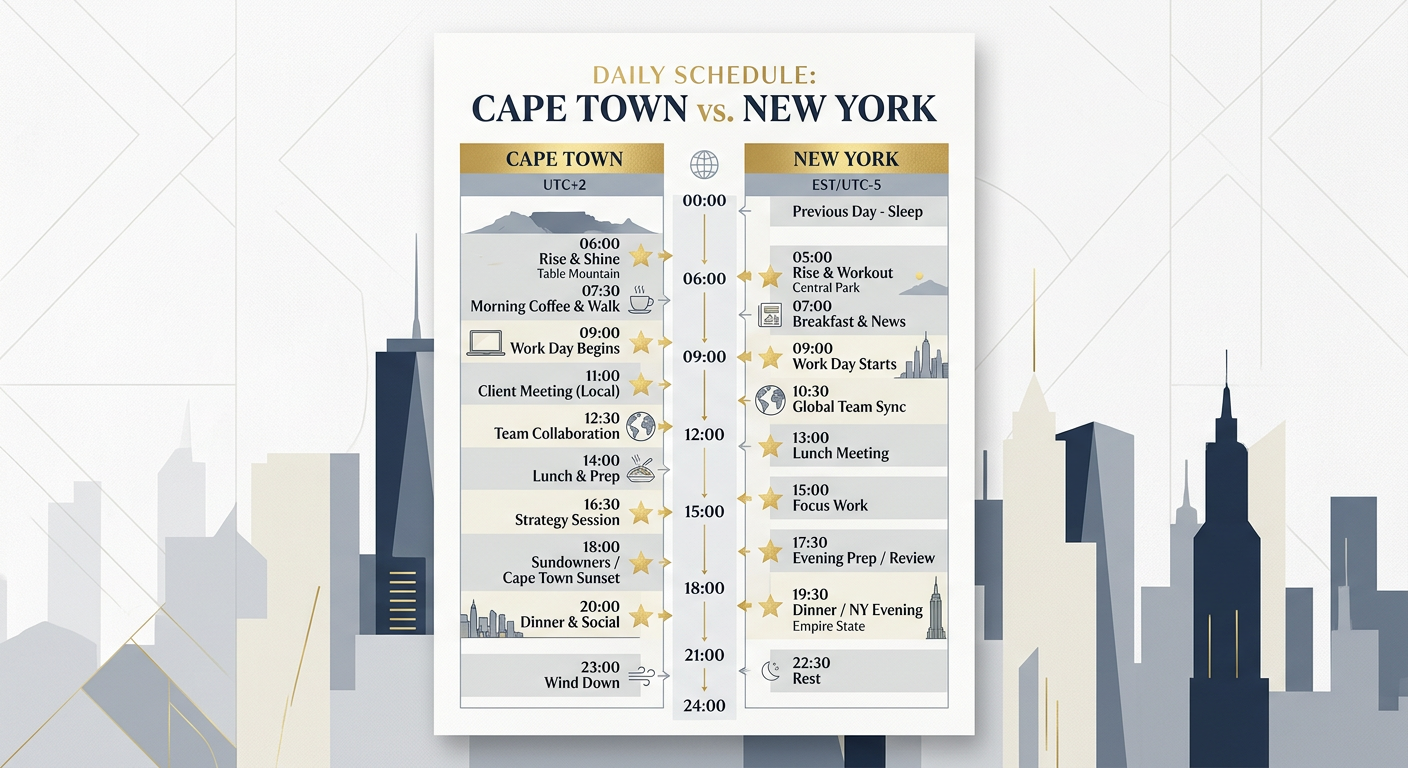
South Africa Standard Time (SAST) is UTC+2 — fixed year-round, with no daylight saving adjustment. The gap between SA and US time zones:
- Eastern (EST/EDT): 6 hours behind SA
- Central (CST/CDT): 7 hours behind SA
- Pacific (PST/PDT): 8–9 hours behind SA
The Overlap Window: More Than Enough
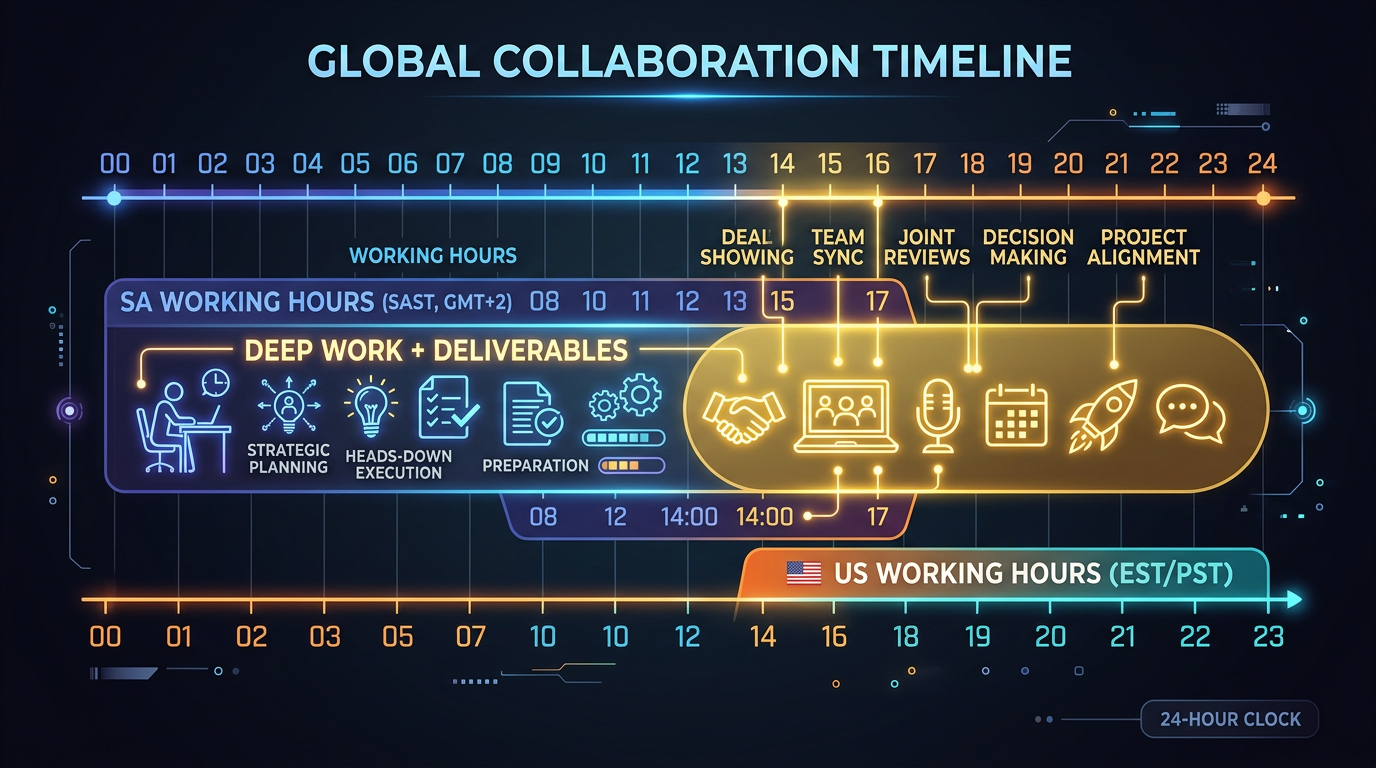
A typical South African professional's day working with a US East Coast team:
- 7:00 AM SAST — Starts work. Reviews messages, begins focused deep work.
- 10:00 AM SAST — Sends daily update and draft reports to US team.
- 3:00 PM SAST (9am EST) — Live overlap begins. Active collaboration: Slack, Zoom, real-time responses.
- 6:00 PM SAST — SA professional wraps up. US team continues into their afternoon.
That's a 3–4 hour live overlap window — enough for a daily stand-up, one or two working sessions, and real-time Slack collaboration.
The Counter-intuitive Advantage: Being Ahead Is Better
Here's the insight most people miss: when your SA professional is 6 hours ahead, they are working while you sleep. You send a request for a revised financial model at 5pm EST on Tuesday. By 9am SAST (3am EST), the revised model is in your inbox. You wake up at 7am EST to a completed deliverable.
This is the "follow-the-sun" workflow used by global law firms and investment banks to create 24-hour productivity cycles. Compare this to a US West Coast hire who is 3 hours behind New York — requests sent at 5pm EST may not be picked up until 2pm PST. The work doesn't move forward overnight. It waits.
"Eight months in, I can honestly say the time zone is basically invisible. Every morning I have a model, a report, or a reconciliation waiting in my inbox that wasn't there when I left the night before. It's like having someone who works while I sleep — because they do."
Marcus, CFO, Chicago
How High-Performing Remote Teams Actually Use This
- Daily async briefing
At the end of your US day, leave a clear briefing document or Loom video. Your SA professional picks it up at the start of their day and has 4–5 hours of focused work before you're online.
- Overlap window for collaboration
Use the 9am–1pm EST window for real-time collaboration — stand-ups, calls, working sessions. Protect it.
- Asynchronous by default, synchronous by exception
The most efficient SA–US teams default to async communication and save real-time calls for decisions that genuinely require live interaction.

Real Talk: Where the Time Zone Gets Hard
Emergency response: If your systems go down at 11am EST, your SA professional is already offline. West Coast heavy teams: All-hands meetings at 5pm PST mean midnight for Cape Town — not sustainable. Culture-heavy environments: If your culture revolves around spontaneous real-time collaboration, the SA model requires more intentional structure.
What This Means for Your Business
For the vast majority of US startups with East Coast or Central time operations and structured processes — the time zone is a manageable and often advantageous factor.